.png)


JSN 2026
THE SONG OF FREE WOMEN
Jesolo Sand Nativity: 2026/2027
Sculpture Reference Guide
19 sculptures: themes, curatorial notes, and direction for artists
This exhibition is a song of freedom, dignity, courage, and hope. Inspired by the Magnificat and by Mary as a free and fully realized woman, child, it looks beyond her romanticized images, toward something deeply human she represents; our capacity to care, resist, speak, and change the world.
We sing with hands that care, vote, write, build, and rise against violence. We sing through movements, unions, cooperatives, schools, families, and communities. Every time a girl studies, a worker organizes, a survivor tells the truth, or one person frees another from fear, the song continues.
These sculptures celebrate women who have helped liberate and celebrate humanity, some remembered by name, countless others unknown. Their actions have opened history to renewed trust and hope.
Here, the boundary between the sacred and ordinary human experience begins to disappear just as in “The newborn child” of George de Le Tour.
Acts of care, vulnerability, courage, and solidarity remind us that sacredness can be found within human life itself.
History, too, is shaped by what we do with what is placed in our hands.
Description of the overall exhibition: This exhibition opens with a girl who belongs to no single era: timeless, standing at the threshold of becoming, watching over everything that follows:
From that timeless opening, the path moves close to home. Maysa Yousef who gathers children into art amid the ruins of present-day Gaza. Mahsa Amini’s dandelion still carries her name on the wind. Malala Yousafzai turning a bullet into a global voice for girls’ education; Rajiya, a Sudanese mother, carrying a grief that recurs in every generation of war; Rita Levi-Montalcini building a laboratory in her own bedroom under racial law; Franca Viola refusing a shame that was never hers; the women of 1946 Italy, who earned rather than received their place at the ballot box. A sculpture of flowers, made to be read by touch, holds many more names and stories at once. From there the exhibition steps back through the twentieth century. Samantha Cristoforetti looks back at all of it from orbit: small, and connected to everyone before her.
{ This text is meant to present the women, not the sculptures content themselves}
Only then does the exhibition reach further back, to Mary: not as a fixed icon, but as a young woman making a series of choices. She questions the angel before she consents. She travels to Elizabeth and is met with joy rather than judgment. She accepts a scandal that was never rightfully hers to bear. Three reimagined Nativities return her story to the hands and bodies of women, before the exhibition closes with its oldest scene: the shepherds, the Holy Family, and the Magi.
The girl who opens the exhibition and the birth that closes it are not opposite ends of a line, but the same question asked twice: what does it take for a woman to hold her ground, whatever century she’s born into. Everything in between is an answer.
Lay out Over view


Contents
Sculpture 1: Strong child, young woman, maiden/fanciulla (Vadim)
Sculpture 2: Maysa Yousef (Radek)
Sculpture 3: Masha (Jina) Amini (Hanneke)
Sculpture 4: Malala Yousafzai (Agnese)
Sculpture 5: Rajiya, a Weeping Mother (Marielle)
Sculpture 6: Rita Levi-Montalcini (Charlotte)
Sculpture 7: NO!: Franca Viola (Nicola Wood)
Sculpture 8: Women of the Republic (Agnese)
Sculpture 9: How it’s made
Sculpture 10: Flowers That Speak (David)
Sculpture 11: Samantha Cristoforetti (Kuba)
Sculpture 12: The Annunciation to Mary (Michela)
Sculpture 13: The Visitation (Nicolai Torkhov)
Sculpture 14, 15, 16: Three Nativities, Reimagined (Pedro)
Sculpture 17, 18, 19: The Nativity Scene (Susanne, Slava, and Dmitrii)
Sculpture 1: Strong child/young woman
maiden/fanciulla
Sculptor: Vadim
Description: Sculpture representing a young female figure, overlooking the exhibition.
I can be curious enough to ask, brave enough to speak, determined enough to continue, compassionate enough to care and hopeful enough to believe that I can make a difference.
Info
She is still a child, standing at the threshold of becoming, with the world still open before her.
She is curious about the world and courageous enough to question it. She carries hope, the quiet belief that tomorrow can be kinder, freer, and more just than today. She is discovering her own voice, learning to speak when something matters and to listen with compassion when others need to be heard. Difficulties are real, but they also reveal her resilience and determination.
Imagination gives her the freedom to explore, create, discover, and dream beyond what others expect of her. She is learning to think for herself while understanding that true strength includes caring for others. She does not yet know where her path will lead, nor does she need to. What matters is that she begins: questioning, dreaming, caring, and finding the courage to take her next step: because even the smallest steps she takes can begin to change the world.
Direction for Artist;
A 3D figurative sculpture with a strong presence, overseeing the exhibition. It could be1 figure.. 2 or 3 figures looking in different directions.
Sculpture 2: Maysa Yousef
Sculptor: Radek
Description: Sculpture representing Gaza artist Maysa Yousef, who keeps hope alive.
An artist with no political power turns siege and loss into a body of work that refuses to let her people be reduced to numbers. Dignity asserted from the very rubble the powerful created, she still manages to give a voice to the marginalized.
Her voice becomes art, expressing life, identity, grief, freedom, hope and helping children process loss through creativity.
Info
Maysa Yousef (also spelled Maysaa or Maisaa Yousef) is a Palestinian visual artist from Gaza. Her art has a strong social and human-rights dimension, addressing war, freedom, women's experiences, Palestinian identity, and life in Gaza. Yousef uses visual art and works with children; her unique voice communicates suffering, defends human dignity, preserves hope, and draws attention to people whose experiences might otherwise be overlooked.
This sculpture explores themes of hope, justice, dignity, and the lifting up of people who have little social power, taking inspiration from her first solo exhibition, "Alice in Palestine" (2021). The closure of the Gaza Strip since 2005 had a deep impact on her, leading her to imagine what would happen if Alice were in Palestine: would she change the reality? Maysa believes Alice, a character she deeply admires, would certainly change things around her, since she sees the world differently and defines her own reality. She draws a parallel between Alice and the Palestinians: stuck in a place like Wonderland, refusing to accept their reality, yet never ceasing to dream, imagining surreal scenarios as they hold onto a subconscious world set apart from the one around them.
"I worked about what my ancestors lived, what I lived, and what my children are living now: occupation, prisoners, siege, freedom, war, loss. Alice in Palestine expressed me and my feelings in the desire to fly, fall, escape, change reality, summarized the details of my life in twenty artworks."
The Dream: As a Palestinian artist, I have spent my life from childhood to this day under occupation, killing, displacement, destruction, detention, blood, martyrs, wounded, siege, bombing. Before, I had many hopes and ambitions. I wished to be a bird flying freely and singing happily, moving from one country to another, breathing freedom. I strongly desired to open my own store with my artwork, as I do in international stores, printing my work in different ways. I also wanted to study art therapy and prepare Alice in Palestine II. Now, my hopes and dreams have changed. My only dream is to survive: my family, my own homeland: and my only hope is to live in peace. I am not a growing number. I am a human being with a story and a message. I am not anonymous. I am Palestinian.
Source: artzonepalestine.net: "Alice in Palestine: Poetry and Beauty Always Make Peace" (G. Elizabeth Bergallo)
Direction for Artist;
Represent the message of Maysa Yousef by finding inspiration in her works and projects . https://www.artzonepalestine.net/reviews/alice-in-palestine-poetry-and-beauty-always-make-peace-g-elizabeth-bergallo


Sculpture 3: Masha (Jina) Amini
Sculptor: Hanneke
Description: Sculpture representing Masha Amini, whose death at the hands of Iran's morality police sparked national and international solidarity around issues of women's rights.
A young woman detained and killed by state power becomes, in death, the thing that state could not contain: a movement scattering like dandelion seed on the wind. The mighty are put down by the very grief they tried to suppress.
Her story became a symbol associated with women's freedom and dignity.
Info
Mahsa (Jina) Amini was a 22-year-old Kurdish-Iranian woman who died in September 2022 after being detained by Iran's morality police in Tehran for allegedly wearing her hijab improperly. Witnesses reported she was beaten while in custody; she fell into a coma and died days later, though authorities disputed accounts of mistreatment. Her death ignited the "Woman, Life, Freedom" (Zan, Zendegi, Azadi) movement: the most sustained wave of protests against Iran's government in years, spreading across the country and drawing international solidarity, particularly around issues of women's rights and compulsory hijab laws.
Two symbols became central to the movement. Cutting off hair in public emerged as an act of protest and mourning, drawing on old Persian and Kurdish traditions in which women cut their hair to express grief or defiance in the face of injustice; during the protests it became a visible, collective gesture of rejecting state control over women's bodies, performed both on the streets in Iran and by supporters abroad.
The dandelion became an emblem of the movement's spirit: associated with wishes, fragility, and resilience, since the flower scatters its seeds to the wind and regrows elsewhere. It came to represent hope carried forward despite violent suppression: the idea that ideas and resistance, like dandelion seeds, could not be fully contained no matter how forcefully authorities tried to stamp them out.
Direction for Artist;
Create a 3D sculpture representing Masha (Jina) Amini and her legacy, using the symbolism of the dandelion or hair cutting or???


Sculpture 4: Malala Yousafzai
Sculptor: Agnese
Description: Sculpture representing Malala Yousafzai, Pakistani activist and Nobel laureate.
Shot for insisting girls belonged in school, she turned an assassination attempt meant to silence her into the youngest Nobel Peace Prize ever awarded. The proud who tried to erase her voice were undone by the reach it gained instead.
Her voice becomes a defense of every girl's right to education.
Info
Malala embodies the prophetic force of the Magnificat raised against the powerful: in her case, the Taliban: fighting for every girl's right to education. She is the youngest-ever winner of the Nobel Peace Prize.
Born in Mingora, in Pakistan's Swat Valley, to a family that ran a school, Malala began blogging anonymously for BBC Urdu as a child, documenting life under Taliban rule and her fight to keep attending school after girls' education was banned in the region. In October 2012, at age fifteen, she was shot in the head by a Taliban gunman in a targeted assassination attempt while riding home on a school bus, but survived after emergency treatment in Pakistan and the UK, where she and her family later settled. Two years later, at seventeen, she became the youngest-ever Nobel Peace Prize laureate, sharing the honor with Kailash Satyarthi for their work on children's rights to education. She went on to found the Malala Fund with her father, became an internationally recognized symbol of resistance to extremist suppression of women and girls, and brought global attention to the cause through her memoir, I Am Malala. She continues her advocacy today, including at the UN, and graduated from Oxford University in 2020.
A young woman finds her voice, confidence, and hope. Malala began speaking publicly for girls' education while still very young, becoming a voice for girls whose opportunities and freedoms are restricted.
Challenging unjust power. She challenged the Taliban's restrictions that barred girls from attending school: refusing to accept silence as the price of survival.
Hope instead of fear. Even after surviving an assassination attempt, Malala continued her advocacy rather than allowing violence to silence her, transforming a deeply personal ordeal into a global movement for millions of girls.
Her work envisions a world in which being born a girl no longer determines whether a person is allowed an education: an injustice she is still working to see overturned.
Direction for Artist;
Inspiration: henna with equations: a personal detail from Malala's own childhood, in which she and her schoolfriends sometimes drew mathematical formulas on their hands instead of traditional patterns, blending cultural tradition with a love of learning. Portrait suggestion: "We Can Do It" style. Possible flower symbolism: lotus, cornflower. Could also draw on illustrations from her children's book, Malala's Magic Pencil. When writing for the BBC Urdu, her pseudonym was “Gul Makai”, which is commonly translated as “cornflower”.


Sculpture 5: Rajiya, a Weeping Mother
Sculptor: Marielle
Description: A Sudanese mother, mourning.
Her grief stands for every mother the world has stopped watching; Sudan, Gaza, Ukraine, the Mediterranean. She embodies the Magnificat’s mercy “from generation to generation”: a hunger for a child that does not return, filled only by the refusal to stop hoping.
Info
Represented as a Sudanese woman, this sculpture gives modern form to an ancient grief. Her name is Rajiya, and like Rachel: the biblical mother who wept for her children and refused to be comforted (Matthew 2:16–18): she represents the sorrow of mothers across every place and time. Here, that grief wears a specific, present-day face: a mother from Sudan, standing for a war the world has largely turned away from.
Rajiya's grief speaks for the children and civilians lost to conflict, and for every family driven from home by violence and hunger. It is not confined to one place: this same grief is carried by mothers in Palestine, Ukraine, and Iran, in Syria and the DRC, in the waters of the Mediterranean, in every home waiting for word that never comes.
Rajiya stands alongside Rachel. Her grief is every mother's grief, finding a new face in every generation.
The name Rajiya is a Sudanese name meaning "to hope" or "to expect." This is fitting because it holds both halves of what the sculpture is trying to say: it names the very thing grief like hers is built around: a mother waiting for a child who does not return, still holding the shape of expectation even after loss has made it unbearable. The name carries the ache of waiting itself, the quiet refusal to stop hoping even when hope has been proven false. But it also reaches past the grief: naming her "hope" alongside her mourning insists that sorrow and hope aren't opposites here, but coexist in her, the way they coexist in every mother who keeps loving forward even while grieving backward. In a sculpture about a Sudanese mother standing in for mothers everywhere, giving her a name that means "hope" turns her from a symbol of pure loss into a symbol of a grief that still, somehow, keeps faith.
Direction for Artist;
3D sculpture of a mourning Sudanese mother. Suggestion: empty arms could represent the loss of a child. Scale up to artist: possible large mourning portrait, face, bust, or full figure.
Sculpture will also be visible on the way out


Sculpture 6: Rita Levi-Montalcini
Sculptor: Charlotte
Description: This sculpture represents a life dedicated to knowledge: a mind placed in service of humanity and science, against arrogance and ignorance.
Barred from every university by racial law, she built a laboratory in her own bedroom and went on to win a Nobel Prize. Excluded by the powerful of her day, she was exalted anyway ; through work no law could reach. Her voice becomes scientific discovery, persistence and intellectual independence.
Info
Born in Turin to a Jewish family, Rita Levi-Montalcini was barred from academic work in 1938 under Mussolini's racial laws. Rather than abandon her research, she built a secret laboratory in her own bedroom, studying chick embryo nerve fibers with only the most basic tools: collecting embryos from local farms and, in the end, cooking the eggs once her work with them was done. She emigrated to the United States in 1947, joining Washington University in St. Louis, where she worked alongside Viktor Hamburger. In the early 1950s, together with biochemist Stanley Cohen, she identified nerve growth factor (NGF), a protein essential to the growth and survival of nerve cells: a discovery that earned her the 1986 Nobel Prize in Physiology or Medicine and laid groundwork for later understanding of cancer, developmental biology, and neurodegenerative disease.
NGF became the first of many "growth factors" now known to shape cell growth throughout the body, influencing fields from oncology to Alzheimer's research. Levi-Montalcini remained scientifically active well into her hundreds, becoming the first Nobel laureate to reach the age of one hundred. She also served as a senator for life in the Italian Senate and founded institutions supporting young scientists and the education of African women, remaining politically and intellectually active until very late in life. She is widely regarded as a symbol of perseverance in science: particularly for women, and for those who continue their work under political persecution.
Her story reflects several enduring truths. The lowly are lifted up: excluded from universities by racial law, she nonetheless became a Nobel laureate and a major public figure in Italy. Power is not the final measure of worth: political authority could strip her of an institutional position, but it could never extinguish her intellectual life, which continued quietly in a makeshift home laboratory. Hope persists amid adversity: her career survived persecution, war, displacement, and exclusion, met always with continued work rather than surrender. And a concern for those denied opportunity carried into her later years, as she worked to expand scientific access and founded a foundation supporting the education and development of African women.
Her signature discovery: nerve growth factor, the mechanism behind the growth and survival of nerve cells: echoes the exhibition's broader themes of life, growth, and a future opened for the vulnerable.
Direction for Artist;
Rita has an amazing face: one of the few older women in this exhibition. Nerve-cell forms can be used as inspiration for texture. Portrait, with interesting visual elements drawn from her life and research (see reference images).


Sculpture 7: NO! Franca Viola
Sculptor: Nicola Wood
Description: This piece honors Franca Viola, the first woman in Italy to publicly refuse a "reparation marriage": an act that made her an early symbol of women's emancipation.
A seventeen-year-old alone against her community, an entrenched legal system, and centuries of custom to which she said no ; and an entire law protecting powerful men eventually fell. The lowly, in her, brought down what had stood for generations.
Her voice becomes the power to say no to an unjust social expectation and to insist on her own choice.
Info
Born in Alcamo, Sicily, in 1948, Franca was seventeen when she was kidnapped and raped in 1965 by Filippo Melodia, a man to whom she had once been engaged and had rejected. Under Italian law at the time, a rapist could escape prosecution entirely by offering his victim "matrimonio riparatore": a reparative marriage widely understood to restore a family's honor. The logic of the time placed the shame not on the man who had committed violence, but on the woman who had survived it, expecting her to erase that shame through marriage to her attacker. Franca refused to accept a shame that was never hers to carry, standing against enormous social pressure and even threats made to her family. Rather than accept the marriage, she and her father pressed charges, leading to one of the first convictions of its kind in Italy.
Her case drew national attention and helped shift public opinion away from honor-based "solutions" to sexual violence. The legal loophole that had allowed rapists to escape punishment through marriage: Article 544 of the Italian penal code: was not formally abolished until 1981, but Franca's refusal is widely credited as the turning point that built momentum toward that reform. She became a lasting symbol of dignity and resistance against a deeply entrenched code of silence and family "honor." In 1968, she married a different man in a ceremony that made headlines in its own right: a public, deliberate statement of her right to choose her own life.
Franca Viola belongs in this project because her courage was quiet but total: a seventeen-year-old girl, alone against her community's expectations, an entrenched legal system, and centuries of custom, who simply said no: and meant it. She refused not only the marriage, but the shame that society tried to hand her: shame that belonged, in truth, to the man who had attacked her. She did not set out to become a symbol; she only declined to let someone else's violence become her own disgrace. In doing so, she gave every woman after her a precedent, proof that the law and the social order built around "honor" could be challenged and changed. Like the other women in this project, she represents the moment an individual act of refusal becomes a turning point for many: dignity asserted against a system built to deny it.
Direction for Artist;
Some graphic inspiration, using the word "NO" in the sculpture, or a graphic hand gesture of "no”. (see reference images) and as always these are just suggestions.


Sculpture 8: Women of the Republic
Sculptor: Agnese
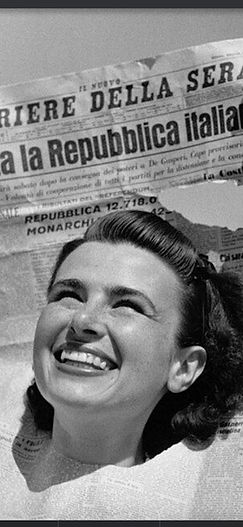
Description: On the 80th anniversary of the Italian Republic, a remembrance of the women of the Republic and their first vote should not be missing.
Unnamed women who carried the Resistance as couriers and nurses stepped, in a single vote, from the margins of political life into the foundation of a republic. Their citizenship was not handed down; like Mary’s own “yes,” it was earned and then claimed.
Info
1946: the moment Italian women stepped into full citizenship: eighty years of the Republic they helped build. Marking eighty years since the birth of the Italian Republic, this sculpture honors the women who cast Italy's first universal vote on June 2, 1946: the referendum that founded the Republic and, in the same act, granted women full citizenship in its democracy.
That vote was not handed down as a gift. Thousands of Italian women had spent the war years as partisans, nurses, and staffette (partisan couriers), smuggling weapons and messages through the Resistance against fascism and Nazi occupation: a mobilization so total it made denying them the vote politically impossible once peace came. The right to vote was decreed in February 1945; the right to stand for office followed in March 1946, after an initial oversight left it out. Women tested this new power first in local elections that spring, then, on June 2, 1946, voted nationally for the first time: helping elect 21 women to the Constituent Assembly that drafted a constitution declaring gender equality in 1948.
This moment belongs in the project because it marks the instant when half a country's population moved from the margins of political life to its very foundation: not through concession, but through having already proven themselves, in the hardest possible circumstances, indispensable to it. The sculpture stands for every woman in that first line at the ballot box: ordinary, largely unrecorded by name, and yet the literal builders of a new republic's legitimacy. Now, eighty years after that first vote, it is a reminder that democratic belonging was not simply given to women: it was earned, claimed, and then written permanently into the country's founding law.
Direction for Artist;
Possible ideas: a woman voting; a famous poster; a woman's head emerging from a newspaper: drawing on well-known period imagery (see reference images).



Sculpture 9: How it’s made
Sculptor: David
Description: 3 small pound up’s that illustrate how the sand sculptures are made
Sculpture 10: Flowers That Speak
Sculptor: David
Description: A tactile sculpture for the blind, representing flowers symbolic of the courage and resilience of women around the world.
Info
This 3D sculpture invites visitors to encounter women's history through touch: flowers whose forms and textures each carry a distinct symbolic weight.
FLOWERS AND THEIR SYMBOLISM { some ideas for flowers}
Mimosa (International Women's Day): its soft, cluster-like texture of tiny round buds marks the Italian tradition of gifting mimosa on March 8th, celebrating women collectively.
Red tulip (Iran): associated with martyrdom and the "Woman, Life, Freedom" movement; its bold, upright cup shape stands for the women who lost their lives resisting compulsory hijab laws.
Violet / pansy (Suffragettes): historically tied to the fight for women's voting rights, its layered, velvety petals evoke the persistence of the suffrage movement.
Sunflower (Ukraine, resilience): tall and turning toward light even in hardship, symbolizing endurance and the resilience of women amid war.
Cornflower (Malala Yousafzai / girls' education): a modest, blue, five-petaled bloom associated with courage and quiet persistence, honoring the fight for girls' right to education.
White rose (Sophie Scholl / the White Rose resistance): purity of conviction and resistance against tyranny; Scholl and her fellow students used the white rose as their emblem against Nazi Germany.
Iris (France / Joan of Arc): the fleur-de-lis-linked iris can represent valor and female leadership in the face of injustice.
Forget-me-not (remembrance): for women whose stories have been erased or forgotten by history.
Purple crocus (women's health advocacy): depending on regional symbolism, purple and teal crocuses are used in health-awareness campaigns tied to women.
Almond blossom (fragility and renewal: Judith, Esther, biblical resilience): fitting for the JSN Woman exhibition's pairing of biblical heroines with contemporary advocates, as almond blossoms appear early each spring as a sign of hope after hardship.
Poppy (remembrance of women lost to war and violence): a widely recognized emblem of memory and sacrifice, complementing the red tulip's meaning for Iran.
Together, the flowers form a continuous tactile narrative: each one a distinct handprint of struggle, resilience, and hope, inviting every visitor, sighted or blind, to "read" women's history through form and texture rather than sight alone.
Sculpture 11: Samantha Cristoforetti
Sculptor: Kuba
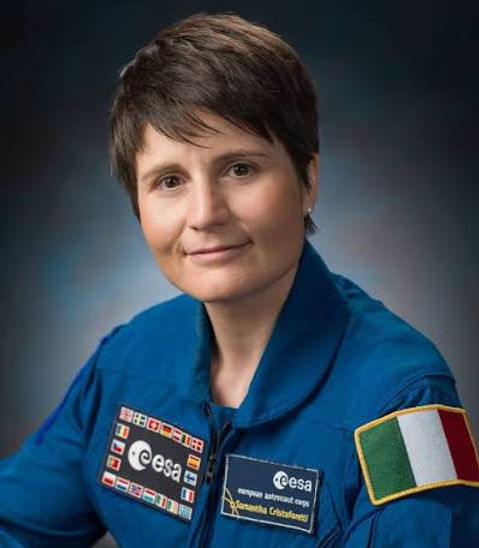
Description: Sculpture representing Samantha Cristoforetti, Italian astronaut who has seen the world from another perspective.
From orbit, she looks back at “the multitude of the world” with humility rather than distance; reach without arrogance. She embodies the Magnificat’s mercy in feeling connected rather than towering over those below.”The firmament is a teacher that humbles and consoles at the same time”
Her voice becomes exploration, science, learning and the courage to go beyond familiar limits.
Info
Born in Milan and raised in Trentino, Cristoforetti trained as a fighter pilot in the Italian Air Force before joining the European Space Agency in 2009. On the "Futura" mission in 2014–2015, she became the first Italian woman in space, setting the record at the time for the longest single spaceflight by a woman at 199 days. She returned to the International Space Station in 2022 for the "Minerva" mission, becoming the first European woman ever to command the ISS.
Beyond the records, Cristoforetti has become one of Europe's most visible science communicators: sharing daily life aboard the ISS with the public, and even brewing the first espresso ever made in space with a custom-designed machine, bringing a distinctly Italian humanity to the vastness of orbit. She is widely regarded as a role model for women in STEM across Italy and Europe, a modern face of achievement in a field that has historically excluded women almost entirely.
Cristoforetti belongs in this project because her achievement is not only about reaching space, but about how she carries it: a woman who broke into one of the most male-dominated fields in human history, then used her position not for distance or prestige, but to bring others closer: sharing what she saw, making the extraordinary feel reachable. She embodies a rare combination of daring and grace, proof that reaching further than almost anyone before you can still leave room for humility about how small, and how connected, we all are.
"Looking up, I see the immensity of the cosmos; bowing my head, I look at the multitude of the world. The gaze flies, the heart expands, the joy of the senses can reach its peak, and indeed, this is true happiness."
Context: Cristoforetti posted these lines from Wang Xizhi's 4th-century text on social media while the International Space Station (ISS) flew over China.
“Perhaps if we looked at things from a cosmic perspective, we’d be more likely to forgive each other our pettiness, to help each other live peacefully during our brief time on earth.
Source: European Commission, Joint Research Center, EU Women of the Future.
Direction for Artist
Visual of the vastness of the universe; the smallness, fragility, and interconnectedness of humans and our planet.




Sculpture 12: The Annunciation to Mary
Sculptor: Michela
Description: The Annunciation to Mary of Jesus's birth.
Gentileschi’s composition literally inverts power, placing Mary above the angel. Mary’s own questioning before consent is the Magnificat in miniature: not passive obedience, but a lowly girl reasoning her way toward a “yes” that will overturn the world’s expectations of her.
Info
Inspired by Artemisia Gentileschi's Annunciation (1630): not a reproduction, but a point of departure: Mary positioned above the angel, who appears in a posture of submission.
This piece draws on one of the most quietly radical moments in scripture: the angel Gabriel appearing to Mary to announce that she will conceive and bear a son, to be called "Son of the Most High" (Luke 1:26–38). What makes the scene powerful is not Mary's passivity, but the opposite: she questions how this can be, being a virgin around twelve years old, and only after Gabriel's explanation does she answer: "Behold the handmaid of the Lord; be it unto me according to thy word." Her consent is not blind obedience but the outcome of genuine reasoning: she weighs what she is told, asks what she does not understand, and only then chooses. In accepting, she also accepts becoming an unwed, pregnant woman in a society where that alone could mean scandal, disgrace, even danger: and she says yes regardless, defying a shame she did not deserve to carry. In her stands a rare balance of humility and boldness: total openness to what is asked of her, joined with the courage to question it first and the courage to face what it would cost her.
The composition takes its inspiration from Artemisia Gentileschi's 1630 Annunciation, in which Mary is painted above the angel, who appears in a posture of submission rather than authority: a striking reversal of how the scene is usually staged. That same reversal of power informs this sculpture's own composition. Gentileschi, one of the great figures of Baroque painting, built her reputation in a world almost entirely closed to women. Raped at seventeen, she endured a public trial in which she was made to testify under torture and public humiliation. Rather than be defined by that violence, she transformed her experience into a body of work dominated by strong, dramatic women: a legacy worth remembering in its own right, and one that deepens the resonance of this particular sculpture.
Together, Mary's questioning consent, her defiance of imposed shame, and Gentileschi's own history of survival and reclamation give this sculpture its double weight: a young woman who reasons her way to her "yes" and accepts its cost, conceived through a composition inspired by an artist who refused to let violence have the final word over her own story.
Another inspiration is Henry Tanner's Annunciation.
One of the rare and innovative reinterpretations of the theme in modern painting. Tanner is an African American artist who lived in Paris. Mary is a real young girl, intimidated, while the Archangel Gabriel is only a vertical column of dazzling light in the domestic space.
Direction for Artist;
Use the painting for inspiration, for example: composition, elements, and reversal of power between the figures. We can look at using light inside sand to explore the light angel idea.


Sculpture 13: The Visitation
Sculptor: Nikolay Torkhov
Description: The Visitation: the meeting between pregnant Mary and Elizabeth.
Mary, barely adolescent and unmarried, is greeted not with suspicion but as “blessed among women.” Here she sings the Magnificat itself ; and the sculpture holds the very moment before that song, when an unwed pregnant girl is met with joy rather than judgment.
Info
This piece draws on the meeting between Mary and her relative Elizabeth (Luke 1:39–45): a scene almost startling in its intimacy once its details are held in mind. Mary, only twelve years old and just newly pregnant, travels to see Elizabeth, who is six months further along, carrying the child who will become John the Baptist. According to the Gospel, the meeting takes place "in the hill country, in a city of Judah": traditionally identified as Ein Karem, near Jerusalem. When Mary arrives, Elizabeth's baby leaps within her, and Elizabeth greets Mary as "blessed among women." What passes between them is not formal or ceremonial, but something closer to recognition: two women, at wildly different life stages, meeting each other in the truth of what they are each carrying, without doubt or judgment.
Mary's response is the Magnificat, a song proclaiming that the lowly will be lifted up and the hungry filled, while the proud and powerful are brought down: among the most socially radical passages in the Gospels, placed in the mouth of a barely-adolescent, unmarried, pregnant girl. It is not a private prayer of gratitude; it is a public declaration of reversal, sung by someone with no power at all.
The composition could take its inspiration, not its likeness, from Pontormo's Visitation, known for the way it holds its two central women in close, almost enveloping proximity: a visual language of nearness and support rather than distance or hierarchy. That same closeness shapes this sculpture: two women bound not by equal circumstance, but by trust, welcome, and shared recognition.
This piece belongs in the project because it captures something rarely centered in art: sisterhood between women as its own form of strength, unmediated by men, in which an unwed, twelve-year-old girl is met not with suspicion but with joy and honor: and where her response, in turn, is not gratitude alone but a fierce, world-overturning song.
Direction for Artist;
Emphasize the contrast between youth and older age, and the sisterhood and trust between the two women.


Sculpture 14, 15, 16: Three Nativities, Reimagined
Sculptor: Pedro
Description: Three sculptures reproducing paintings that reimagine the Nativity through motherhood and women's care.
Info
These three sculptures are reproductions of paintings that each, in their own way, step outside the conventional Nativity scene to offer something more intimate, more physical, or differently framed. Together, they open up an alternative view of Christ's birth: one told not through angels, kings, or theological grandeur, but through the female body, female care, and female presence at the very center of the sacred. Where the traditional Nativity often stages the birth as a public, witnessed event, these three works turn inward, toward the women who carried, delivered, and protected that first life: offering a Nativity built from motherhood itself rather than around it. Seen together, they trace a single female-centered arc: the sacred held in the body before birth, the sacred delivered into an unfamiliar and distant world without fanfare, and the sacred protected afterward by the quiet vigilance of women. Where traditional Nativity imagery often looks outward: to shepherds, stars, and kings: these three reproductions look inward, toward the women who made the story possible in the first place.
Sculpture 14: Paul Gauguin, La Naissance du Christ / The Birth of Christ (1896).
An all-female birth scene transplanted to a distant land strips the Nativity of European staging and returns it to something universal: birth belongs first to women, wherever the powerful set their story.
Gauguin's Nativity transplants the Gospel entirely into another culture, imagining an all-female birth scene in a distant, unfamiliar land where the sacred and the everyday exist side by side without tension. Stripped of the European visual conventions that usually surround this story, the scene becomes something more elemental: birth as a matter handled among women, plainly and without ceremony. It is relevant here because it strips the Nativity of its usual staging and returns it to something closer to universal human experience: however the story is told, across whatever culture, birth belongs first to women.
Sculpture 15: Piero della Francesca, Madonna del Parto (1460).
Pregnancy itself becomes sanctuary ; the sacred held entirely within a woman’s body, before any manger or witness. The Magnificat’s exaltation of the lowly begins here, literally inside her.
Not a Nativity scene at all in the traditional sense, this painting captures the moment just before: a pregnant Mary, her hand resting at the opening of her gown, gesturing toward her own womb. There is no manger, no child yet born; the sacred is held entirely within her body. Piero della Francesca treats pregnancy itself as a kind of sanctuary, the pregnant form as sacred architecture: the actual, physical site where the divine is becoming incarnate. It belongs in this trio because it centers motherhood not as a backdrop to the miracle, but as the miracle's very location.
Sculpture 16: Georges de La Tour, The Newborn Child (1640).
Two women keep watch over a newborn by candlelight, with no angels or kings in sight. Protection and tenderness carried out by women in the dark are, the piece insists, the first true acts surrounding the incarnation ; mercy at its quietest.
De La Tour's painting reframes the Nativity as an intimate, candlelit scene of two women: Mary and Saint Anne: watching over the newborn Christ. There are no shepherds, no wise men, no theatrical staging of the sacred; only a single flame, a hushed room, and the quiet, practiced care of women tending to new life. Its power lies in how ordinary it makes the divine: this could be any birth, any family, any night. It belongs here because it insists that protection and tenderness: carried out not by angels but by women, in the dark: are themselves the first true acts surrounding the incarnation.
Direction for Artist
Reproduce each painting faithfully in high to low relief form, preserving its composition and central female focus.


Sculpture 17, 18, 19: The Nativity Scene
Sculptor: Susanne, Slava, and Dmitry
Description: Sculptures 16, 17, and 18 form a single Nativity scene: the shepherds, the Holy Family, and the Magi: conceived as three separate pieces made by different sculptors working in coordination, so that each stands independently while completing one unified scene.
Sculpture 17: The Shepherds
Sculptor: Susanne
Description: Shepherds receiving the angels' announcement of Jesus’ birth.
Young women sent to the fields’ edge, among the lowest-status workers of their world, are the first to hear that a king has been born. The proud were not told first; the announcement went to those with the least power to matter.
Info
This piece depicts the moment shepherds in the fields receive the angels' announcement of Christ's birth: a scene traditionally shown alongside the Nativity itself, the two events unfolding almost simultaneously, echoing one another across the same night. Here, the shepherds are shown as young women, a detail rooted in historical practice: in many rural communities of the period, tending sheep often fell to unmarried daughters, sent out to watch the flocks at the edges of the settled world.
Sculpture 18: The Holy Family / The Nativity
Sculptor: Slava
Description: Mary, age twelve-fourteen, holding newborn Jesus to her chest, set in a cave with round, organic forms; Joseph shown as loving and accepting.
A silent, unwitnessed birth in a cave, Mary holding her son close: the Magnificat’s promise made flesh, in the plainest possible setting. No one notices the movement it sets in motion.
Info
A silent birth, one among many. No one notices the movement it sets in motion. Mary, like every mother, holds her child close to her breast.
The setting is a cave, rendered in soft organic shapes rather than architecture, keeping the scene simple and elemental. The family is tender and loving; Joseph's posture is one of quiet acceptance and care as Mary tends to the child. The animals present are given only a small role: the emphasis stays on the intimacy between mother, father, and child where the public feel like extended family.
Sculpture 19: The Magi
Sculptor: Dmitry
Description: The three Magi, on their way, moving toward the Nativity with the gifts.
Court astrologers from the East ; men of standing ; travel toward a child born to nobody powerful, guided by nothing but a star and a persistence that outlasts even the star’s disappearing. The proud come to kneel before the lowly; the reversal is complete.
Info
From far away the Magi come to Bethlehem, following the star: a thought, a movement of the heart that says: a child has been born, a king. And when the star disappears, they continue searching.
Matthew 2:1–12: The Magi. Wise men from the East follow a star to find the child, bring gifts of gold, frankincense, and myrrh, and are warned in a dream not to return to Herod.
The Gospel text is spare about who these figures actually were. The Greek word used, magoi, originally named a priestly caste of Zoroastrian astrologer-priests from Persia: not "wise men" in a general sense, but a recognized professional class known across the ancient world for astrology, dream interpretation, and ritual knowledge. By the time Matthew was writing, the term had broadened to cover astrologers and scholars from across "the East," including Babylonia, Persia, and Arabia, though its root remains Persian and Zoroastrian.
Three regions are most plausible as their origin. Persia and Parthia connect directly to the term's roots and carry political weight for a Roman-era audience, since Parthia was Rome's regional rival: foreign dignitaries from the East paying homage to a new "king" would not have read as a neutral gesture. Babylon was a major center of astrology and astronomical record-keeping, with a long-established Jewish community dating to the Babylonian exile, giving both the star-watching tradition and a plausible route into Judea. Arabia is favored by some scholars because of the gifts themselves: gold, frankincense, and myrrh were all Arabian trade goods, with frankincense and myrrh sourced specifically from southern Arabia and the Horn of Africa: and later Christian tradition, drawing on Isaiah 60 and Psalm 72's kings of Sheba bringing gold and incense, leaned toward this reading.
Functionally, the Magi were most likely court astrologers or astrologer-priests: the kind of figures attached to Eastern royal courts who tracked celestial events for political and religious significance, since a new star would have been read as marking a shift in power. Matthew's account assumes its audience already knows what a magos is and does, offering no explanation: they are a recognizable type rather than named individuals from a single homeland. The number three and the idea of them as kings are both later tradition, not present in the text itself: three comes from the three gifts, and the royal status was applied retroactively from Old Testament prophecy.